 Irishman Gifts
Durable Articulated Dragons for Children: A Parent's Guide

Table of Contents
- What Makes an Articulated Dragon Durable Enough for Children?
- PLA vs PETG for 3D Printed Toys: Which Material Survives Play?
- Articulated Dragon Toy Safety: Age Suitability and Small Parts
- Size, Poseability, and Design: Matching the Dragon to the Child
- Side-by-Side Buying Criteria for Articulated Dragons
- How to Care for 3D Printed Toys: Cleaning, Repair, and Storage
- Conclusion
- Frequently Asked Questions
Last Updated: October 23, 2026
What Makes an Articulated Dragon Durable Enough for Children?
A durable articulated dragon for children is one built with thick joint connectors, clean layer adhesion, and a material that bends instead of snapping. At Irishman Gifts, we finish every dragon by hand.
Most buying guides skip that point. They show a photo of a coiled dragon and call it durable. Here is what actually matters when a child picks one up.
Joints, Layer Lines, and the Weak Points to Inspect
Look at three places before you buy. First, the ball-and-socket joints: they should move with resistance, not flop. Second, the thin connectors between segments, which is where most breakage starts. Third, the layer lines on the tail tip and horns, the thinnest printed areas.
A common mistake is judging a dragon by its size. A large dragon with skinny joints fails faster than a small one with thick ones.
PLA vs PETG for 3D Printed Toys: Which Material Survives Play?
Material choice is the single biggest predictor of whether an articulated dragon survives a child. The three materials you will see in listings, PLA, PETG, and resin, behave very differently under bending, dropping, and heat, and most listings do not tell you which one you are buying.
PLA (polylactic acid) is stiff and prints with crisp detail, which is why it dominates display dragons. Its weakness is brittleness: under a sharp impact or repeated bending at a thin joint, PLA cracks rather than flexes. PLA also softens at relatively low temperatures, so a dragon left on a car dashboard or in a sunny window can warp and lose joint fit.
PETG (polyethylene terephthalate glycol) flexes before it breaks, which is why it is the better default for a handled toy. A PETG joint that is bent past its range tends to deform and spring back rather than snap. The trade-off is detail: PETG strings more, shows layer lines more readily, and cannot hold the fine scale texture that PLA or resin can.
Resin (typically UV-cured photopolymer) captures the sharpest detail of the three, but cured resin is brittle and chips rather than bends. It is a collector and shelf-display material, not a play material, and it should not be sold to a household with a toddler who mouths toys.
| Material | Flexibility | Break Risk Under Play | Heat Sensitivity | Best For |
|---|---|---|---|---|
| PLA | Low, stiff | Higher at joints and thin sections | Warps in a hot car or sunny window | Display, gentle fidget handling |
| PETG | Moderate | Lower, deforms before snapping | More heat-tolerant than PLA | Kids who play rough |
| Resin | Very low | High, chips, does not bend | Can soften and lose detail in heat | Collectors, shelf display |
What Buyers Should Ask About Material and Manufacturing
"3D printed" on a listing tells you nothing about how the toy will behave. Ask the seller four questions before you pay:
- Which material, exactly? "PLA," "PETG," or "resin", not "eco-friendly plastic." Get it in writing in the listing or the order confirmation.
- What infill and wall count? A dragon printed with two walls and low infill is lighter and weaker at the joint than one with three or more walls. Sellers who print for play will usually tell you.
- How is the model oriented on the print bed? A joint printed so its layer lines run across the bending direction splits along those layers. Orientation is the hidden variable most listings never mention.
- Is the piece finished by hand? Hand-finished edges and cleaned seams reduce sharp nubs and stringing that catch on small fingers.
A common pattern among small-batch makers is to print play dragons in PETG with thicker walls and display dragons in PLA or resin for detail. If a seller cannot tell you the material and wall count, treat the durability claim as unverified.
That does not make PLA useless. Many makers sell PLA dragons as display pieces and gentle fidget toys, and discussion of PLA brittleness in printed models reflects that same trade-off. If the child is rough, ask for PETG.
Articulated Dragon Toy Safety: Age Suitability and Small Parts
Age suitability for an articulated dragon comes down to three things: small parts, joint integrity, and supervision. Most listings give you an age number and nothing else, so here is how to read that number and what to check yourself.
Small Parts and Choking Hazards
The federal small-parts standard for toys intended for children under three is a cylinder roughly 1.25 inches in diameter and 2.25 inches deep, the same size as a cardboard toilet paper tube. If a piece can fit inside that cylinder, a child under three should not have unsupervised access to it. On an articulated dragon, the pieces to check are removable horns, eyes, accessories, and any joint cap or connector that can work loose over time.
A fully printed, one-piece articulated dragon with no glued or snap-in parts is the safer choice for a household with a toddler, because there is nothing to detach. A dragon with glued-on eyes or push-in horns introduces a part that can fail under repeated handling, and a failed part is a choking hazard, not just a cosmetic flaw.
Joint Integrity as a Safety Issue
A joint that is too loose is a safety problem, not just a play problem. Loose joints let segments separate, and a separated segment is a small part. Before handing a dragon to a child, bend every joint through its full range and check that no segment pops free. If a joint separates with light force, the toy is not suitable for a child who will handle it unsupervised.
Reading the Age Label
A listing that says "age 3 and up" is making a claim, not proving one. Under the US Consumer Product Safety Commission toy safety requirements, toys intended for children 12 and under are expected to meet applicable safety rules, and manufacturers and importers are responsible for labeling and testing. A marketplace listing is not the same as independent testing, so ask the seller directly whether the toy has been tested to CPSC requirements and whether the age rating reflects small-parts testing.
A practical rule we follow: if a piece can fit inside a cardboard toilet paper tube, a child under three should not have unsupervised access to it.
Supervision by Age Band
- Under 3: Only one-piece dragons with no detachable parts, and only with direct supervision. Mouthing is the primary risk.
- 3 to 5: Articulated dragons are appropriate if joints are firm and no parts detach. Supervise around younger siblings who may mouth the toy.
- 6 and up: Most children can handle a fully articulated dragon independently, but check joints periodically for loosening and retire the toy if segments separate.
When in doubt, choose the simpler dragon. A one-piece articulated body with no glued accessories is easier to inspect, easier to clean, and easier to keep safe.
Size, Poseability, and Design: Matching the Dragon to the Child
Size is the most overrated spec and the most useful one, depending on the child. A 24-inch flexible dragon suits a kid who wants a lap-sized companion. A 63-inch dragon is a statement piece that drapes across a shelf and rarely leaves the house.
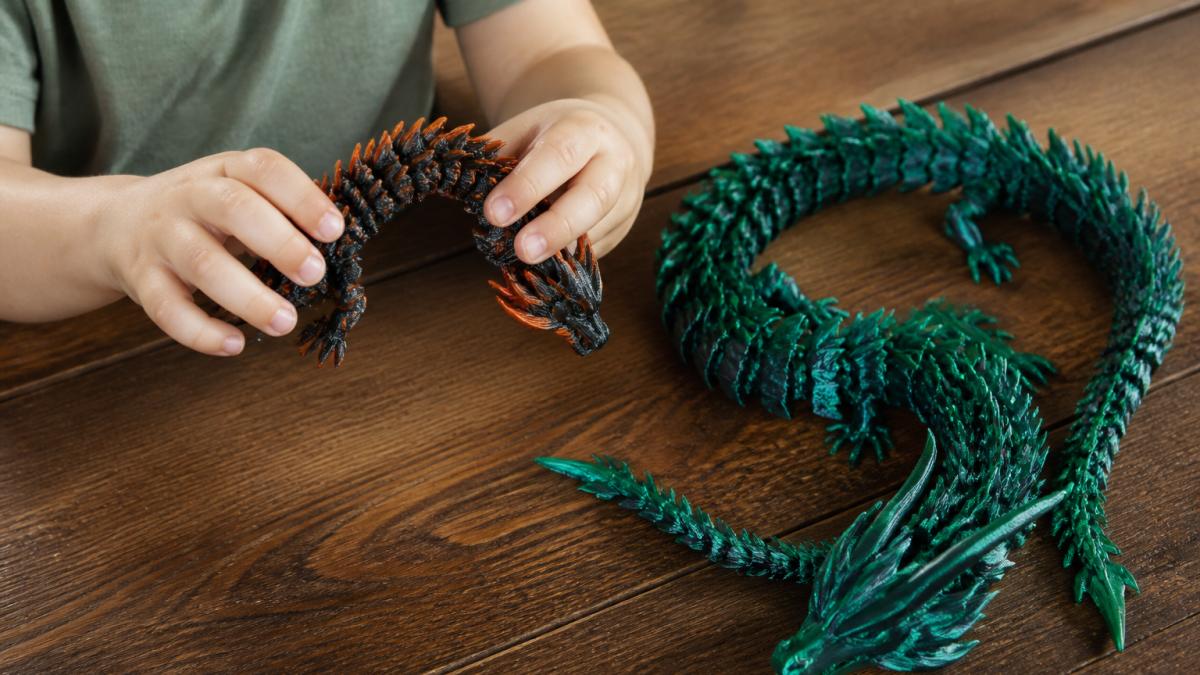
Poseability follows joint count. A fully articulated dragon with many segments can coil, walk, and hold a dynamic pose. Fewer segments mean a stiffer toy that holds one shape.
Match the design to the child, not the trend. A crystal dragon in translucent filament looks striking on a desk but shows scratches. A matte finish hides handling marks better. Boys and girls both gravitate to the coiled pose more than to any particular color.
Side-by-Side Buying Criteria for Articulated Dragons
Judge every dragon on the same five criteria, and the choice gets simple. Compare material, joint thickness, listed size, age guidance, and finish quality. Ask for the material in writing, because "3D printed" alone tells you nothing about how it will behave.
| Criterion | What to Check | Red Flag |
|---|---|---|
| Material | PLA, PETG, or resin stated | Material not listed |
| Joints | Thick connectors, firm movement | Loose or paper-thin joints |
| Size | Listed length and weight | Length only, no photos for scale |
| Age guidance | Stated rating and small parts | No age rating at all |
| Finish | Hand-finished edges, clean seams | Visible strings or sharp nubs |
Price and value sit outside that table on purpose. Availability and shipping matter too: a birthday gift ordered three weeks out needs a seller who confirms lead time before you pay.
This is where a small-batch studio differs from a marketplace listing. We build to order, finish each dragon by hand, and can tell you the material and joint construction before you buy. Our collection shows finished pieces rather than renders.
How to Care for 3D Printed Toys: Cleaning, Repair, and Storage
Care is simple and most owners skip it. Wipe with a damp cloth and mild soap, never a dishwasher or hot water, because heat softens printed parts and warps joints. Store the dragon uncoiled or loosely coiled so joints are not held under tension for months.
At end of life, PLA and PETG parts are recyclable in some municipal programs, though not all accept them. Check locally before binning a broken dragon.
Conclusion
Buying a durable articulated dragon for children comes down to a short checklist: confirm the material, inspect the joints, match the size to the child, and verify age guidance before you pay.
Irishman Gifts builds each dragon by hand in small batches, with material and joint construction we can explain before you order. Browse the collection to see finished pieces and current lead times.
Frequently Asked Questions
What makes an articulated dragon durable enough for children?
Durability comes down to three things: material, joint design, and layer adhesion. PETG flexes before it cracks, while standard PLA is stiffer and can snap if dropped on a hard floor. Look for dragons with rounded, thick joint loops rather than thin pins, and ask the maker whether the model was printed with enough walls and infill. A hand-finished piece from a small studio usually gets inspected before shipping.
Are 3D-printed articulated dragons safe for young children?
Safety depends on age and construction. Some retail listings describe articulated dragons as suitable for ages 3 and up, but small printed parts can break off under rough handling, so anything that fails a gentle bend test should stay away from toddlers. For children under 3, treat these as display pieces only. For older kids, check that joints move freely without cracking, confirm there are no sharp edges from support removal, and supervise the first few play sessions.
Can articulated dragon toys break if children bend them too much?
Yes. Every articulated dragon has a limit at the joint loops, and repeated bending in the same spot is the most common cause of failure. Standard PLA versions are described as brittle and better suited to display and gentle fidgeting than rough play. PETG and resin blends tolerate more flex. Teaching kids to move joints through their full range slowly, rather than yanking or twisting, extends the life of the toy considerably.
How should you clean and care for a 3D-printed dragon toy?
Wipe the surface with a damp cloth and a drop of mild dish soap, then dry it fully before storage. Avoid dishwashers, hot cars, and direct sunlight, since heat softens printed parts and can warp thin joints. Store the dragon uncoiled or loosely posed so the joints aren't under constant tension.
Finding a dragon that survives real play takes more than a pretty listing. Irishman Gifts hand-finishes every articulated dragon, confirms the material and joint construction up front, and builds in small batches so you know what arrives. Shop the collection to see finished pieces and current lead times.

Frequently asked questions
What makes an articulated dragon durable enough for children?
Durability comes down to three things: material, joint design, and layer adhesion. PETG flexes before it cracks, while standard PLA is stiffer and can snap if dropped on a hard floor. Look for dragons with rounded, thick joint loops rather than thin pins, and ask the maker whether the model was printed with enough walls and infill. A hand-finished piece from a small studio usually gets inspected before shipping.
Are 3D-printed articulated dragons safe for young children?
Safety depends on age and construction. Some retail listings describe articulated dragons as suitable for ages 3 and up, but small printed parts can break off under rough handling, so anything that fails a gentle bend test should stay away from toddlers. For children under 3, treat these as display pieces only. For older kids, check that joints move freely without cracking, confirm there are no sharp edges from support removal, and supervise the first few play sessions.
Can articulated dragon toys break if children bend them too much?
Yes. Every articulated dragon has a limit at the joint loops, and repeated bending in the same spot is the most common cause of failure. Standard PLA versions are described as brittle and better suited to display and gentle fidgeting than rough play. PETG and resin blends tolerate more flex. Teaching kids to move joints through their full range slowly, rather than yanking or twisting, extends the life of the toy considerably.
How should you clean and care for a 3D-printed dragon toy?
Wipe the surface with a damp cloth and a drop of mild dish soap, then dry it fully before storage. Avoid dishwashers, hot cars, and direct sunlight, since heat softens printed parts and can warp thin joints. Store the dragon uncoiled or loosely posed so the joints aren't under constant tension.