 Irishman Gifts
Personalized Cruise Cabin Door Signs: Ideas & Materials
Table of Contents
- Why Personalized Cruise Cabin Door Signs Matter
- Cruise Cabin Door Decoration Ideas for Every Occasion
- Cruise Door Sign Wording Ideas That Stand Out
- Custom Cruise Door Magnets and Attachment Methods
- Cruise Cabin Door Sign Materials: What Works and What Doesn't
- Ordering Timelines and Personalization Workflow
- Cruise Line Policies and Cabin Door Rules
- Frequently Asked Questions
Last Updated: October 5, 2026
Why Personalized Cruise Cabin Door Signs Matter
A personalized cruise cabin door sign transforms your stateroom from anonymous to distinctly yours, signaling to fellow cruisers that your cabin is a destination, not just a room number.
Cruise cabin door signs mark your family's territory on a crowded ship, commemorate the occasion, and spark hallway conversations.
The right cabin door decoration can elevate a cruise experience, injecting personality into a standard stateroom and celebrating the moment visibly.
Cruise Cabin Door Decoration Ideas for Every Occasion
Cruise cabin door decoration ideas span every occasion, from a family of eight to a honeymoon couple, each deserving something that reflects their specific celebration.
Family and Group Cruises
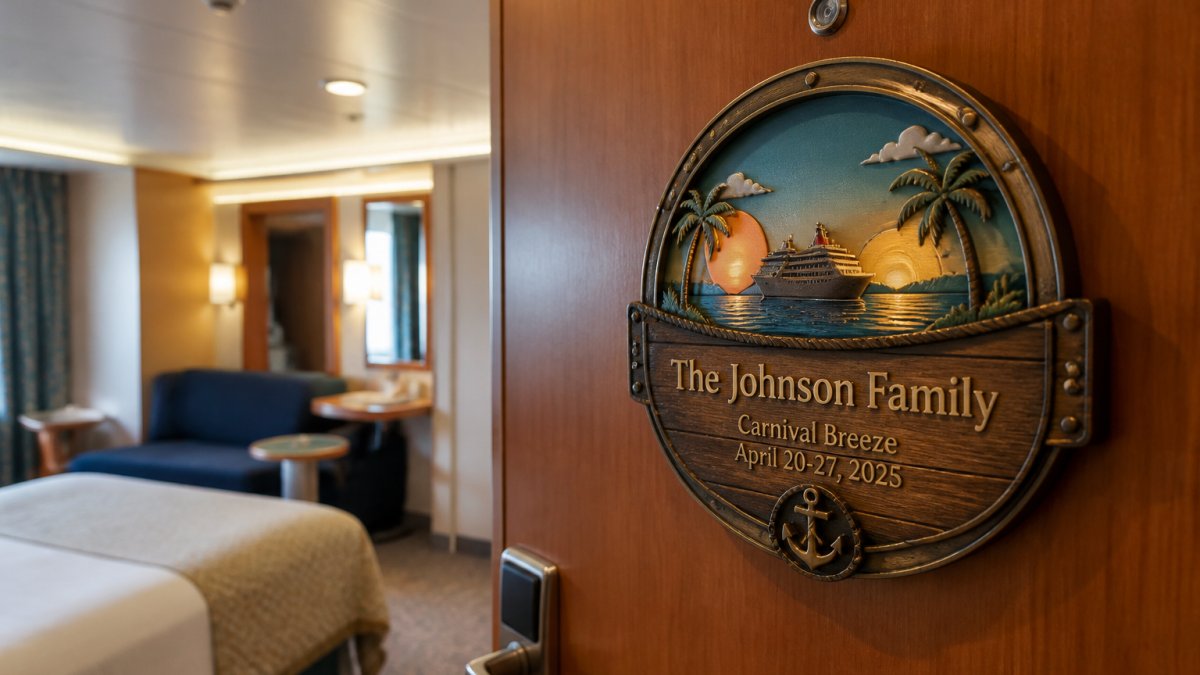
Family cruises call for signs showcasing everyone's names or a unified message.
Consider designs listing all family members' names, the ship name and sailing date, or a playful motto, "Smith Family Caribbean Adventure 2026" or "Five Generations at Sea."
The best family cruise signs balance impact with readability: feature the family name prominently and add sailing dates or a short message underneath rather than cramming in 12 names.
Milestone Sailings: Birthdays, Anniversaries, and Honeymoons
Honeymoon signs carry romantic weight: couples choose designs with their names, wedding date, and nautical or tropical themes, announcing to the entire ship that this is a special moment.
Birthday designs benefit from bright colors and the age prominently displayed, a 50th deserves gold accents or bold numbers. Anniversary signs can lean elegant or playful depending on the couple's style.
Funny and Playful Themes
Humor transforms a cruise cabin door sign into entertainment, creating a sense of community, cruisers remember and talk about the funny signs they spotted.
Popular themes include "We're on a boat," "Cabin 7: Where the Magic Happens," "Shh...We're Sleeping Off Last Night," fictional occupations like "Chief Margarita Officer," or puns tied to the destination.
The key with playful designs is ensuring the humor translates visually: a joke must be readable from several feet away and memorable enough that strangers smile.
Cruise Door Sign Wording Ideas That Stand Out
The words on your cruise cabin door sign set the tone: generic wording blends in, while specific, personal wording makes your sign memorable.
Strong cruise door sign wording includes the ship name and sailing date, which anchor the sign to a specific voyage and make it a keepsake.
Avoid generic phrases like "Welcome Aboard" unless paired with personal details.
Feature the ship name prominently, it adds authenticity and makes the sign feel custom-built for that voyage, not mass-produced.
Custom Cruise Door Magnets and Attachment Methods
Most cabin doors on mainstream ships are steel and will hold a magnet, but "most" is not "yours." Before ordering, confirm whether your specific door is ferrous and whether your cruise line permits your attachment method, getting this wrong is the most common reason a personalized sign stays in a suitcase.
Test your door before you buy
A few practical checks:
- Carry a neodymium disc magnet on embarkation day. A thin fridge magnet is a weak test, it may slide on a lightly ferrous surface. Use a small neodymium disc (roughly 1/2 inch, N42 grade or higher). If it snaps firmly, a magnetic sign will hold; if it slides, plan for a non-magnetic method.
- Check the door, not the frame. On many ships the door leaf is steel but the frame, trim, and peephole area may be aluminum or composite. A sign that only overlaps the frame can fall even when the door is magnetic.
- Watch for curved or recessed doors. Some suite and accessible cabins have recessed or beveled doors, so a flat rigid sign may contact only a narrow strip, cutting holding force dramatically.
Magnet strength: what actually holds a sign
Holding power depends on magnet grade, magnet count, sign weight, and how flat the sign sits against the door. A few rules of thumb:
- Neodymium (rare-earth) magnets are the reliable choice. N42 and N52 grades resist vibration and temperature swings far better than ceramic or flexible magnetic sheet.
- Flexible magnetic sheet (thin, peel-and-stick) is the weakest option. It works for lightweight paper and vinyl decals but struggles with rigid signs, especially on a door bumped by carts and foot traffic.
- More magnets beats one big magnet. Four small neodymium discs at the corners distribute load and resist peeling better than one large center magnet.
A practical target: the sign should require a deliberate pull to remove, but not so much force that you risk scratching the door finish.
When the door is not magnetic
If your door fails the magnet test, you still have options:
- Over-the-door hook. A hook hanging over the top edge needs no ferrous surface. Keep the sign light and ensure the hook does not interfere with the door closing.
- Suction cup on glass or smooth surfaces. Works on balcony doors and some interior panels, but suction cups fail in humidity, check daily.
- Freestanding or tabletop sign. A small easel sign inside the cabin near the entry violates no door rules.
- Ask the line. Guest services can sometimes tell you the door material for your cabin class before you sail.
A quick decision path
- Confirm your line permits door decorations.
- Test the door with a neodymium magnet on day one.
- If it holds, use a magnetic sign with four corner magnets under about a pound.
- If not, switch to an over-the-door hook or freestanding sign.
- Never rely on adhesive as your primary method.
This is the step most buyers skip, and it is the difference between a sign that stays put and one that ends up on the floor outside your cabin.
Cruise Cabin Door Sign Materials: What Works and What Doesn't
The material you choose determines durability, appearance, weight, and reusability.
Magnetic Materials and Metal Compatibility
MDF (medium-density fiberboard) is lightweight, affordable, and accepts paint and graphics well, but it absorbs moisture and can warp in humid ship environments.
Acrylic or rigid plastic resists moisture and salt air better than MDF.
Metal backing (aluminum or steel) provides maximum durability and works perfectly with magnets, it won't warp and resists salt air.
Resin-backed signs offer a premium option. Irishman Gifts specializes in handcrafted resin cruise ship keepsakes that combine artistic quality with practical function.
Durability, Weather, and Reuse
Cruise ship environments test materials relentlessly: salt air, humidity, temperature swings, and direct sunlight degrade lower-quality materials.
Acrylic, metal, and resin all handle ship conditions well. Paint and graphics should be UV-resistant to prevent fading.
Reusability matters for cruisers who take multiple voyages.
Decide whether you want new dates and ship names each cruise or a design that works across multiple voyages, removable signs support both.
Ordering Timelines and Personalization Workflow
Understanding lead times prevents last-minute stress. Custom cruise cabin door signs require time for design, production, and shipping.
Standard production runs 5-14 business days depending on complexity and order volume, with rush options sometimes available for a fee.
To avoid delays, order at least 3-4 weeks before departure to accommodate revisions, production, and shipping.
For custom handcrafted pieces like those from Irishman Gifts, allow additional time, hand-finished items require meticulous attention to detail.
Cruise Line Policies and Cabin Door Rules
Door decoration rules are set by each cruise line and can change between sailings, so the only reliable answer comes from the line itself. What you can control is how you ask, when you ask, and what you keep in writing.
What the rules typically cover
Across the major lines, restrictions fall into a few buckets:
- Attachment method. Magnets are most widely accepted; adhesives, tape, putty, and anything leaving residue are most commonly banned.
- Size and coverage. Some lines cap decoration size or require it not extend beyond the door, anything larger risks blocking the corridor or a neighbor's door.
- Safety and signage. Nothing may cover the cabin number, peephole, door handle, evacuation or safety placards, or the sprinkler and detector area.
- Content. Offensive or political decorations, or those readable as safety or crew instructions, are routinely removed.
A small number of lines or ships prohibit door decorations entirely, uncommon but real, and the reason you confirm rather than assume.
The exact questions to ask
Contact your cruise line before you order, ideally 4-6 weeks out, leaving time to change your design if a rule blocks it. Ask these in one message:
- Are magnetic decorations permitted on cabin doors on my sailing?
- Is there a maximum size or weight?
- Are adhesive or hook-based attachments allowed, or magnets only?
- Are there material restrictions (no paper, no fabric)?
- Must the cabin number and peephole remain visible?
- Does the rule differ by cabin class or ship?
Why the answer can change
Two cruisers on the same line can get different answers because rules vary by ship, itinerary, and when the policy was last updated. A few patterns:
- Newer and larger ships sometimes have more specific decoration guidance than older vessels.
- Holiday and themed sailings may loosen or tighten rules around decorating contests.
- Policy pages are updated quietly. A rule you read last year may no longer be current.
Treat any blog post or forum answer, including this one, as a starting point, not a final ruling. The line's own confirmation is the only version that protects you.
If a crew member objects
Stay calm and cooperative, crew are enforcing policy, not judging your sign. If you have written confirmation, share it politely. If the line still asks you to remove it, comply; you can usually relocate a freestanding or in-cabin sign without losing the celebration. Design your sign so it can be displayed inside the cabin near the entry if the door is off-limits.
Plan for the rule, not around it
The safest approach is a sign that works under the strictest common rules: magnetic, lightweight, sized to the door, and never adhesive. Confirm the policy, keep the confirmation, and build in a fallback display option, that combination removes almost all the risk from this purchase.
Frequently Asked Questions
What materials work best for cruise cabin door signs?
Magnetic materials like high-quality vinyl magnets and MDF (medium-density fiberboard) with magnetic backing are ideal for cruise cabin doors because most stateroom doors are metal. Avoid adhesive-only options, as they may violate cruise line policies and won't hold up to cabin humidity and temperature changes. Resin and 3D-printed materials with magnetic attachment systems offer durability and a premium look that resists wear during travel.
How long does it take to order a personalized cruise door sign before my trip?
Ordering timelines depend on complexity, customization, and production capacity. Hand-finished, small-batch items typically require 2-4 weeks for production plus shipping time. Order at least 4-6 weeks before your cruise to account for personalization, proofing, and delivery. Always confirm lead times with the maker before placing your order.
Are cruise cabin doors magnetic, and will my sign stay attached?
Yes, most cruise ship cabin doors are metal and magnetic. Magnetic signs and hooks work reliably on these doors. Quality magnetic attachments, such as strong rare-earth magnets or magnetic backing on resin pieces, hold securely even with cabin movement and humidity. Avoid lightweight magnets; opt for products specifically designed for cruise use that have been tested for durability and won't fall off during your voyage.
What should I avoid putting on a cruise cabin door sign?
Avoid anything that violates cruise line policies: adhesives that damage paint, sharp edges, items larger than cabin-door dimensions, or decorations that block safety information. Skip offensive language, excessive clutter, or designs that obstruct the door's function. Check your cruise line's specific cabin decoration rules before ordering. Most lines allow magnetic decorations but prohibit permanent adhesives and anything that could be a safety hazard.
Frequently asked questions
What materials work best for cruise cabin door signs?
Magnetic materials like high-quality vinyl magnets and MDF (medium-density fiberboard) with magnetic backing are ideal for cruise cabin doors because most stateroom doors are metal. Avoid adhesive-only options, as they may violate cruise line policies and won't hold up to cabin humidity and temperature changes. Resin and 3D-printed materials with magnetic attachment systems offer durability and a premium look that resists wear during travel.
How long does it take to order a personalized cruise door sign before my trip?
Ordering timelines depend on complexity, customization, and production capacity. Hand-finished, small-batch items typically require 2-4 weeks for production plus shipping time. Order at least 4-6 weeks before your cruise to account for personalization, proofing, and delivery. Always confirm lead times with the maker before placing your order.
Are cruise cabin doors magnetic, and will my sign stay attached?
Yes, most cruise ship cabin doors are metal and magnetic. Magnetic signs and hooks work reliably on these doors. Quality magnetic attachments—such as strong rare-earth magnets or magnetic backing on resin pieces—hold securely even with cabin movement and humidity. Avoid lightweight magnets; opt for products specifically designed for cruise use that have been tested for durability and won't fall off during your voyage.
What should I avoid putting on a cruise cabin door sign?
Avoid anything that violates cruise line policies: adhesives that damage paint, sharp edges, items larger than cabin-door dimensions, or decorations that block safety information. Skip offensive language, excessive clutter, or designs that obstruct the door's function. Check your cruise line's specific cabin decoration rules before ordering. Most lines allow magnetic decorations but prohibit permanent adhesives and anything that could be a safety hazard.