
The Durable Articulated Dragon Material Guide
Last Updated: October 28, 2026
Quick Summary
The best filament for a durable articulated dragon is PETG for most makers, because it deforms and recovers at the joints and resists impact. Choose PLA for display pieces, TPU when flexibility matters more than crisp detail, and treat ABS, ASA, and nylon as specialist options.
- PETG strings more and sticks at tight clearances, so tune retraction and lower the temperature to the spool's recommended range.
- A 0.2 mm layer height balances strength and speed on joint-heavy models.
- Use low-density gyroid infill and three perimeters to strengthen segments without bridging joint gaps.
- Lay the dragon flat with joints parallel to the build plate so each joint flexes as designed.
- Flex every joint through its full range right after the print cools to catch failures early.
Table of Contents
- Why Articulated Dragon Durability Starts With Material Choice
- The Best Filament for an Articulated Dragon: A Material-by-Material Comparison
- PLA vs PETG for 3D Printing: Which Holds Up on a Print-in-Place Dragon
- How to Choose an Articulated Dragon STL That Prints and Moves Well
- Slicer Settings That Decide Whether Joints Move or Fuse
- How to Prevent 3D Prints From Breaking: Testing, Troubleshooting, and Repairs
- Ordering a Hand-Finished Articulated Dragon From Irishman Gifts
- Frequently Asked Questions
Why Articulated Dragon Durability Starts With Material Choice
A durable articulated dragon material guide starts with material choice. At Irishman Gifts, we finish every item by hand.
The Best Filament for an Articulated Dragon: A Material-by-Material Comparison
The best filament for an articulated dragon is PETG for most makers, PLA for display pieces, and TPU when flexibility matters more than crisp detail. But "best" only means something if you know how each plastic behaves at a joint, the thin, flexing bridge between two segments where every dragon eventually fails. This comparison is organized around that failure point rather than around printability alone.
| Material | Flexibility at joints | Impact resistance | Layer adhesion | Print difficulty | Best for |
|---|---|---|---|---|---|
| PLA | Low, snaps rather than bends | Low, brittle | Moderate; weak in thin sections | Easy | Display-only dragons, fine detail |
| PETG | Moderate, deforms and recovers | High | High; strings at tight clearances | Moderate | Handling and light play |
| TPU | High, stretches and returns | High | High, but soft | Hard | Flexible builds, gentle handling |
| ABS/ASA | Low-moderate | Moderate | Moderate; warps without enclosure | Hard | Heat resistance |
| Nylon | High | Very high | High, but moisture-sensitive | Hard | Maximum durability, experienced makers |
If you want the full material and safety picture for younger handlers, our guide to durable articulated dragons for children covers what holds up to real play.
PLA vs PETG for 3D Printing: Which Holds Up on a Print-in-Place Dragon
PETG's drawbacks are real. It strings more, sticks to itself at tight clearances, and needs slower print speeds. Tune retraction and drop the temperature into the recommended range on the spool to control stringing. If you want the full material and safety picture for younger handlers, our guide to durable articulated dragons for children covers what holds up to real play.
How to Choose an Articulated Dragon STL That Prints and Moves Well
A good articulated dragon STL is designed around joint clearance, not just visual detail. If you are shopping rather than printing, see this guide to unique fantasy gifts for dragon collectors. The model file decides whether your printer can even produce working joints, so evaluate geometry before you slice.
Slicer Settings That Decide Whether Joints Move or Fuse
Joint clearance is set by the model, but slicer settings decide whether that clearance survives the print. Small errors here fuse segments into a single rigid lump. The useful way to think about settings is not "stronger is better" but "which direction does this setting push the joint", toward durability, toward fusion, or both.
Start with these adjustments:
- Layer height: 0.2 mm balances strength and speed; finer layers improve surface finish but increase print time and the number of layer interfaces where a joint can fuse
- Infill: low-density infill with a gyroid pattern gives internal support without adding weight; very high infill stiffens segments and can bridge joint gaps
- Wall count: three perimeters strengthen thin segments without filling joint gaps; more walls add stiffness but also bulk near clearances
- Print speed: slower speeds improve layer adhesion on PETG; rushing a joint-heavy model is one of the most common causes of weak segments
- Cooling: moderate cooling prevents warping while keeping layers bonded; too much cooling on PETG hurts layer adhesion
- Orientation: lay the dragon flat with joints parallel to the build plate so each joint flexes in the plane the designer intended
How to Prevent 3D Prints From Breaking: Testing, Troubleshooting, and Repairs
Knowing how to prevent 3D prints from breaking starts with a repeatable test: flex every joint through its full range immediately after the print cools. For ongoing care, learn how to clean articulated resin dragons safely without damaging the joints. Work slowly from head to tail and note any segment that resists or clicks.
Ordering a Hand-Finished Articulated Dragon From Irishman Gifts
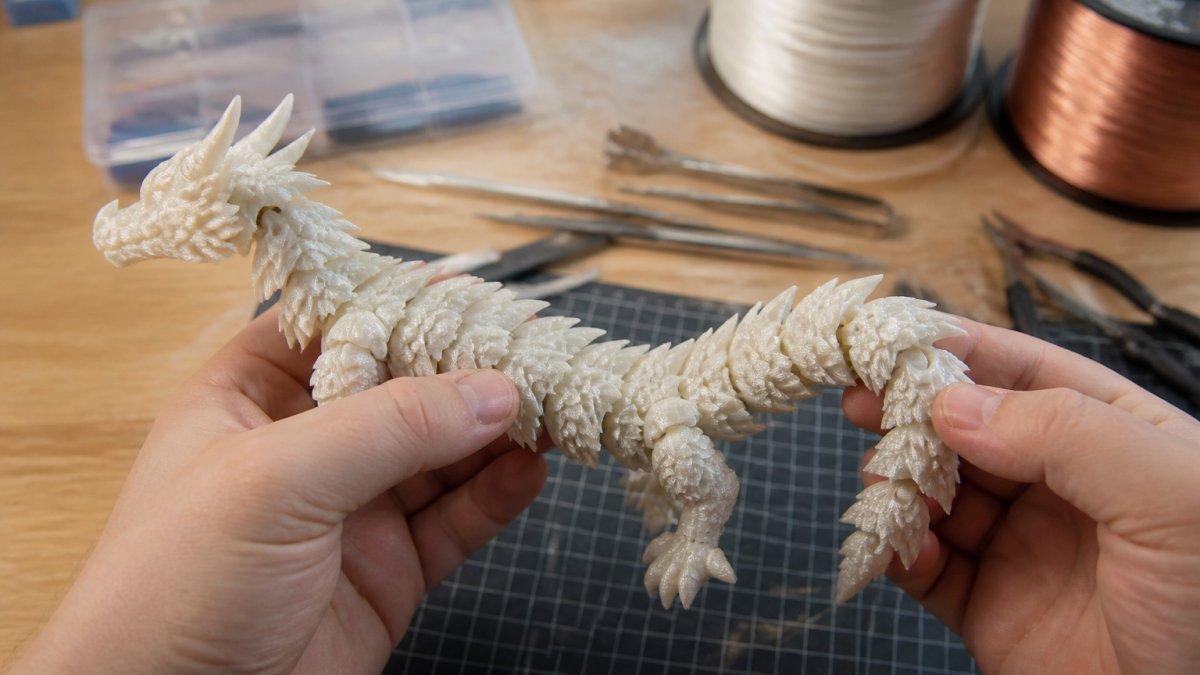
At Irishman Gifts, each item is finished by hand. Browse the Crystal Ice Dragon for a fully articulated dragon with every scale sculpted like fractured ice. You can order a fully poseable articulated dragon dressed in hand-placed blossoms.
Frequently Asked Questions
What material is best for a durable articulated dragon?
PETG is the usual pick for a durable articulated dragon that gets handled. It flexes before it snaps, bonds well between layers, and tolerates drops better than PLA. PLA prints cleaner and holds sharper detail, so it suits display pieces that stay on a shelf. TPU gives the most flex in the joints but is harder to print cleanly. Match the material to how the dragon will be used, not to what prints easiest.
Are 3D-printed articulated dragons fragile?
They can be, and the weak points are predictable: thin tail segments, small leg joints, and the tips of horns or wings. Most breakage traces back to low wall count, poor layer adhesion, or joints printed with too little clearance so they fuse. A dragon printed with three perimeters, calibrated temperature, and correct joint clearance flexes freely and survives normal handling. Treat it as a moving model rather than a toss-around toy and it lasts.
Is PLA or PETG better for an articulated dragon?
For durability, PETG wins. It has more give, so a dropped dragon bends instead of shattering, and its layer bonding is stronger in the direction that matters for thin joints. PLA is stiffer and more brittle, but it prints with finer detail and less stringing. If the dragon is a display piece, PLA is fine. If a child or a frequent handler will move it, choose PETG.
How can I keep the joints on a print-in-place dragon from breaking?
Give the joints room to move. Set joint clearance in the STL or slicer so segments do not touch, keep wall count at three perimeters so each link has substance, and avoid over-extrusion, which welds moving parts together. Print at a temperature in the middle of the filament's range so layers bond without stringing. After printing, work each joint gently while the print is still slightly warm to free any light adhesion.
How do you remove an articulated dragon from the build plate safely?
Let the plate cool first. On a textured or smooth PEI sheet, most prints release on their own once the bed drops below about 40°C. If the dragon still holds, flex the plate rather than prying with a scraper, and work from the base outward. Never pull on the tail or a leg to lift the model, because that is exactly how thin segments snap before the print is even finished.
How should I care for a 3D-printed articulated dragon?
Keep it out of direct sun and away from car dashboards, since heat softens PLA and can warp thin parts. Dust it with a soft brush or a burst of compressed air rather than washing it, because water trapped in the joints encourages grime and, in PETG, can loosen inserts over time. Store it flat or hanging by the body, not by a single limb. If a joint stiffens, work it gently rather than forcing it.
If you've ever watched a printed dragon stiffen at the joints or crack at the tail, you know durability is a design decision, not luck. We'd rather build one dragon that survives years of handling than ten that look good on a shelf. Get started with Irishman Gifts and order a hand-finished articulated dragon built to move.

Frequently asked questions
What material is best for a durable articulated dragon?
PETG is the usual pick for a durable articulated dragon that gets handled. It flexes before it snaps, bonds well between layers, and tolerates drops better than PLA. PLA prints cleaner and holds sharper detail, so it suits display pieces that stay on a shelf. TPU gives the most flex in the joints but is harder to print cleanly. Match the material to how the dragon will be used, not to what prints easiest.
Are 3D-printed articulated dragons fragile?
They can be, and the weak points are predictable: thin tail segments, small leg joints, and the tips of horns or wings. Most breakage traces back to low wall count, poor layer adhesion, or joints printed with too little clearance so they fuse. A dragon printed with three perimeters, calibrated temperature, and correct joint clearance flexes freely and survives normal handling. Treat it as a moving model rather than a toss-around toy and it lasts.
Is PLA or PETG better for an articulated dragon?
For durability, PETG wins. It has more give, so a dropped dragon bends instead of shattering, and its layer bonding is stronger in the direction that matters for thin joints. PLA is stiffer and more brittle, but it prints with finer detail and less stringing. If the dragon is a display piece, PLA is fine. If a child or a frequent handler will move it, choose PETG.
How can I keep the joints on a print-in-place dragon from breaking?
Give the joints room to move. Set joint clearance in the STL or slicer so segments do not touch, keep wall count at three perimeters so each link has substance, and avoid over-extrusion, which welds moving parts together. Print at a temperature in the middle of the filament's range so layers bond without stringing. After printing, work each joint gently while the print is still slightly warm to free any light adhesion.
How do you remove an articulated dragon from the build plate safely?
Let the plate cool first. On a textured or smooth PEI sheet, most prints release on their own once the bed drops below about 40°C. If the dragon still holds, flex the plate rather than prying with a scraper, and work from the base outward. Never pull on the tail or a leg to lift the model, because that is exactly how thin segments snap before the print is even finished.
How should I care for a 3D-printed articulated dragon?
Keep it out of direct sun and away from car dashboards, since heat softens PLA and can warp thin parts. Dust it with a soft brush or a burst of compressed air rather than washing it, because water trapped in the joints encourages grime and, in PETG, can loosen inserts over time. Store it flat or hanging by the body, not by a single limb. If a joint stiffens, work it gently rather than forcing it.