
Is Durable Resin for Kitchen Accessories Worth It?
Last Updated: October 30, 2026
Quick Summary
Durable resin is a fully cured epoxy piece that resists scratching, heat, water, and yellowing under normal kitchen use, driven by the formulation, mixing ratio, and cure schedule. It suits serving and display, but it is softer than glass or stone and should never touch hot cookware or a dishwasher.
- Fully cured, food-safe, and FDA compliant are three different claims that listings often use interchangeably.
- Never place a hot skillet or baking sheet directly on a resin tray; use a trivet or folded towel.
- Hand wash resin accessories in warm water with mild dish soap, rinse, and dry immediately.
- Resin generally trails glass and stone on heat and scratch resistance but is lighter with lower break risk.
- Minor scratches can often be polished out, but heat clouding and deep gouges are usually permanent.
Table of Contents
- What Durable Resin for Kitchen Accessories Actually Means
- Quick Comparison: Durable Resin Options for Kitchen Use
- Food-Safe Epoxy Resin for Serving Trays: What the Labels Do and Do Not Promise
- Resin Tray Heat Resistance and Scratch Durability in a Working Kitchen
- How to Clean Resin Kitchen Accessories Without Dulling the Finish
- Custom Resin Serving Trays for Gifts: What to Check Before You Order
- Resin Versus Wood, Glass, and Stone for Kitchen Accessories
- Repair and Long-Term Maintenance: Making a Resin Tray Last
- Frequently Asked Questions
What Durable Resin for Kitchen Accessories Actually Means
Durable resin for kitchen accessories review starts with one uncomfortable truth: the word "durable" on a resin listing tells you almost nothing.
Durable resin is a fully cured epoxy or resin piece that resists scratching, heat, water, and yellowing under normal kitchen use. Three things drive that outcome: the resin formulation, the mixing ratio, and the cure schedule.
Get any of those wrong and the piece looks fine on arrival and fails within months.
Fully Cured, Food-Safe, and FDA Compliant Are Not the Same Claim
These three phrases get used interchangeably in listings. They are not the same thing.
- Fully cured describes the state of the resin. It is a process claim, and it depends on the maker following the mixing ratio and cure time.
- Food-safe is a marketing phrase with no fixed legal definition for resin craft pieces.
- FDA compliant means the material meets a specific FDA regulation for its intended use. It does not automatically cover a handmade tray used as a serving surface.
The FDA guidance on food contact substances explains that compliance is tied to a defined intended use. A resin poured for a tabletop and a resin poured for a serving tray are not the same application.
That distinction matters more than any star rating.
Quick Comparison: Durable Resin Options for Kitchen Use
Here is how the main options stack up for kitchen work. We are comparing resin systems and finished pieces, not identical products, so read the "best for" column carefully.
| Option | Form | Best For | Watch Out For |
|---|---|---|---|
| Irishman Gifts resin serving trays | Finished, hand-poured piece | Gifting and display serving | Hand wash only, no dishwasher |
| Stone Coat Countertops Epoxy kits | Gallon kit, pour-yourself | Countertop and large surface projects | Food-contact suitability not established |
| Promise Epoxy Resin kits | Kit, pour-yourself | General craft and coating projects | Verify application details before use |
| Superclear Tabletop Epoxy | Tabletop kit | Coating flat surfaces | Not verified for direct food contact |
| TotalBoat Table Top Epoxy | Tabletop kit | Bar tops and coating work | Check cure specs before serving use |
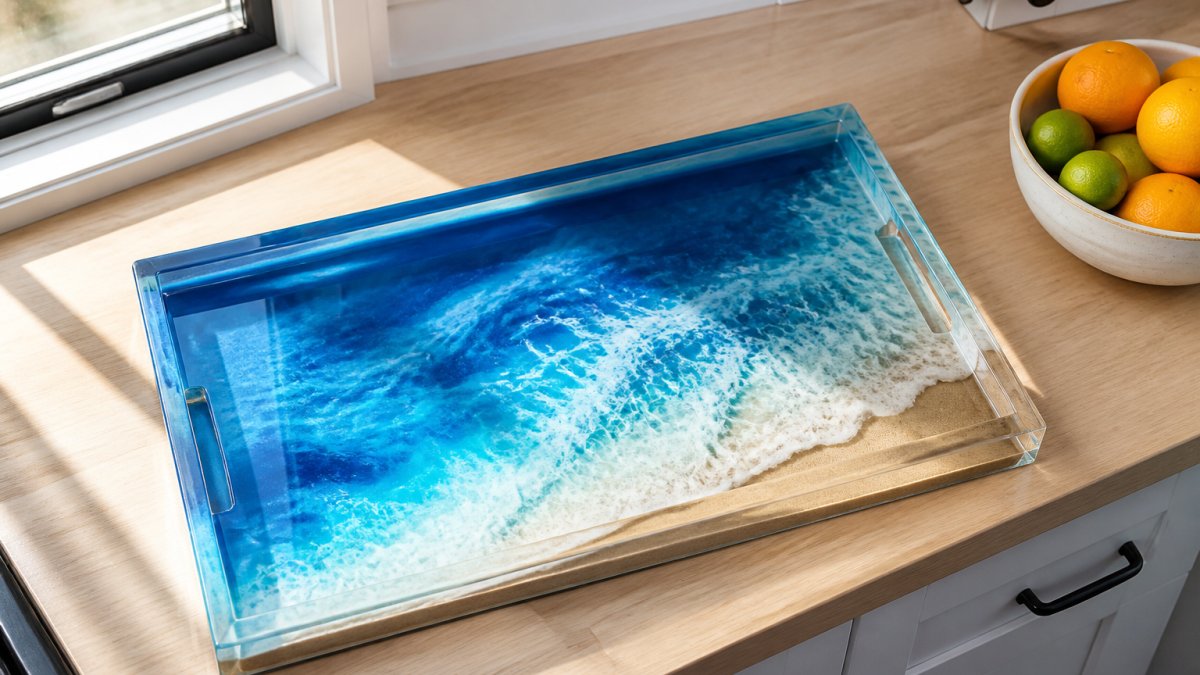
If you want a finished piece rather than a pour-yourself project, you can browse the resin serving tray in our wave-pattern design, or shop the full resin collection to see every kitchen piece we make to order.
Food-Safe Epoxy Resin for Serving Trays: What the Labels Do and Do Not Promise
A food-safe epoxy resin for serving trays label promises the material was formulated for food-contact use.
Most guides skip this.
What to check on any resin tray listing:
- Does the maker state the resin system by name?
- Is there a stated full cure time, not just a demold time?
- Does the piece have a topcoat or sealer, and is that coating food-contact rated?
If a listing answers none of those, treat the food-safe claim as decoration.
For a deeper look at how tray listings compare on food safety and care, our breakdown of a Heartlandcraft alternative for resin trays walks through the same checklist.
Resin Tray Heat Resistance and Scratch Durability in a Working Kitchen
Resin tray heat resistance is the weak point nobody advertises. Most two-part epoxy systems used for kitchen accessories have a glass transition temperature (Tg) well below the temperature of a hot pan or a baking sheet straight from the oven.
What that means in practice:
- Never place a hot skillet, baking sheet, or pot directly on a resin tray. Use a trivet or a folded towel under anything straight from the stove.
- Keep resin away from open flame and the top of a hot oven.
- Do not put resin trays in the dishwasher, microwave, or freezer. Dishwasher cycles combine heat and prolonged water exposure, which is the fastest way to cloud a cured surface.
Scratch resistance is the second weak point. Cured epoxy is nonporous but relatively soft compared with glass or stone. Search results on epoxy countertops note that the surface scratches easily despite being nonporous, and a resin tray is softer than a countertop pour.
Kitchen-Specific Wear Testing: What We Actually Look For
Generic tabletop claims do not tell you how a piece behaves next to a stove. When we evaluate a resin accessory for kitchen use, we run the same small set of checks on every piece and disclose the conditions so you can compare like with like:
- Hot-cookware contact. Place a room-temperature plate, then a warm (not hot) serving dish, on the surface for a short interval and inspect for imprint or gloss change. A trivet is still required for anything from the stove.
- Repeated washing. Hand wash with mild dish soap and a soft cloth, dry immediately, and repeat across many cycles. Watch for clouding at the edges and around any inlay.
- Acidic foods and oils. Leave a cut lemon, a splash of vinegar, or a film of cooking oil on the surface for a short contact time, then wash. Cured epoxy is generally resistant, but unsealed sanded edges and topcoats are the first places to show dulling.
These are qualitative checks, not lab tests. The point is consistency: same conditions, same inspection, so a hands-on finding is distinguishable from a product claim.
UV Resistance, Yellowing, and the High-Gloss Finish Over Time
Yellowing is the slow failure mode. Resin exposed to direct sun shifts toward amber over time, and a crystal clear pour shows it fastest. Non-yellowing formulations slow this down. They do not stop it. Keep resin trays out of direct sunlight, store them in a cabinet rather than on a sunny windowsill, and expect a high-gloss finish to dull slightly with years of washing.
That dulling is normal wear, not a defect. A light polish brings back most of the shine. Deep heat clouding, by contrast, is usually permanent.
How to Clean Resin Kitchen Accessories Without Dulling the Finish
Wash resin kitchen accessories by hand in warm water with a drop of mild dish soap, using a soft cloth. Rinse, dry immediately with a lint-free towel, and never soak the piece.
That is the whole method. The damage comes from what people add to it.
- Skip abrasive pads, scouring powder, and melamine sponges.
- Skip ammonia-based glass cleaners and acetone.
- Skip the dishwasher, even on a gentle cycle. Heat and prolonged water exposure cloud the surface.
For stubborn residue, a soft cloth with mild soap and a little patience beats any stronger chemical. For more on caring for handcrafted pieces, see our unique resin art for home decor guide.
Custom Resin Serving Trays for Gifts: What to Check Before You Order
Custom resin serving trays for gifts fail as presents for one reason: the buyer orders too late. Hand-poured resin is not a same-week product.
Before ordering a custom tray as a gift, confirm four things:
- Production time. Ask how long the pour, cure, and finish take, and add shipping on top.
- Customization limits. Ask what can actually be changed: colors, pattern, size, engraving.
- Shipping and return policy. Custom pieces are usually final sale, so know that before you pay. You can review our shipping and policies for production times and sale terms.
Resin Versus Wood, Glass, and Stone for Kitchen Accessories
Resin generally trails glass and stone on heat and scratch resistance, while offering a lighter weight and a lower break risk. But the right choice depends on how the piece will be used, not on a single scorecard. Here is the trade-off in kitchen terms.
| Material | Heat Resistance | Scratch Resistance | Weight | Break Risk | Maintenance |
|---|---|---|---|---|---|
| Resin | Low | Low to moderate | Light | Low | Hand wash, dry immediately, keep out of sun |
| Wood | Moderate | Moderate | Light | None | Oil periodically, can stain and warp |
| Glass | High | High | Moderate | High | Dishwasher-safe, chips and shatters |
| Stone | High | High | Heavy | Moderate | Seal some types, can chip |
Wood needs oiling and can stain from acidic foods and oils. It handles warm serving dishes better than resin but warps if soaked. Glass and stone handle heat and scratches but chip and shatter, and stone is heavy enough to be awkward for a large serving tray. Resin sits in the middle: tough enough for serving, not tough enough for a cutting board.
Matching the Material to the Kitchen Job
- Serving and display (room-temperature food, light use): resin is a good fit. It is light, colorful, and forgiving of knocks.
- Hot dishes straight from the oven: stone or glass. Resin will soften or imprint.
- Everyday prep and cutting: wood or plastic boards. No resin accessory should be a cutting surface.
If you want a finished piece rather than a pour-yourself project, you can browse the resin serving tray in our wave-pattern design, or shop the full resin collection to see every kitchen piece we make to order.
Repair and Long-Term Maintenance: Making a Resin Tray Last
Minor scratches on a resin tray can often be polished out with a fine compound. Deep gouges usually cannot be fixed invisibly, and a cloudy surface from heat damage is permanent.
Long-term maintenance comes down to three habits:
- Store the tray flat, with nothing heavy on top.
- Keep it out of sun and away from heat sources.
- Wash and dry it immediately after every use.
Do those and a hand-poured tray holds its finish for years. Skip them and even a well-made piece ages fast.
Frequently Asked Questions
Is epoxy resin safe for food contact after it cures?
A fully cured epoxy surface is the point where most manufacturers make their food-contact claim, but curing and food safety are separate questions. Check the specific product's label for an FDA-compliant food-contact statement, and confirm the maker used that product for the surface you will eat from. Many tabletop epoxies are sold for furniture and countertops, not direct food contact. For serving trays, ask the maker which resin they used, how long it cured, and whether the food-facing surface is rated for contact.
How durable are resin serving trays in daily kitchen use?
Durable resin resists water and wipes clean easily, but it is not scratch-proof. Knives, abrasive scrubbers, and heavy ceramic stacked on the surface will mark it over time. A tray used for carrying drinks, cheese, or coasters holds up well; one used as a cutting surface will not. Look for a high-gloss, fully cured finish, ask about scratch resistance, and treat the tray as a serving piece rather than a work surface.
Can resin kitchen accessories withstand heat?
Heat is the weak point. Most epoxy tabletop resins soften or distort well below the temperature of a hot pan, and a serving tray left near an open burner or under a hot dish can warp or cloud. Use trivets, let cookware cool first, and never put a resin tray in a dishwasher or microwave. If you need a surface for hot items, choose wood or stone instead and keep the resin tray for room-temperature serving.
How should you clean and care for resin serving trays?
Wash by hand with lukewarm water and a drop of mild dish soap, then dry with a soft cloth. Skip abrasive pads, bleach-heavy cleaners, and alcohol-based sprays, which can dull the high-gloss finish. Do not soak the tray or put it in a dishwasher, since heat and prolonged water exposure can cloud the surface or loosen an edge. Store it flat or upright away from direct sun to slow yellowing, and wipe spills promptly.
What are the downsides of using epoxy resin for kitchen accessories?
The main downsides are scratch vulnerability, limited heat tolerance, and yellowing with UV exposure over time. Resin also needs careful mixing ratios and full cure time to reach its stated strength, so a rushed batch is a weaker batch. For gifts, the trade-off is uniqueness and a clear, glossy finish against the care it requires.
Most resin kitchen accessories fail for predictable reasons: heat, scratches, and dishwashers. None of those are the resin's fault, and all of them are avoidable with the right piece and the right care. Irishman Gifts pours every resin tray to order and finishes it by hand, with layered color work, a full cure before it ships, and free US shipping on every order. Get started with Irishman Gifts and choose a serving tray built to be used, not just displayed.

Frequently asked questions
Is epoxy resin safe for food contact after it cures?
A fully cured epoxy surface is the point where most manufacturers make their food-contact claim, but curing and food safety are separate questions. Check the specific product's label for an FDA-compliant food-contact statement, and confirm the maker used that product for the surface you will eat from. Many tabletop epoxies are sold for furniture and countertops, not direct food contact. For serving trays, ask the maker which resin they used, how long it cured, and whether the food-facing surface is rated for contact.
How durable are resin serving trays in daily kitchen use?
Durable resin resists water and wipes clean easily, but it is not scratch-proof. Knives, abrasive scrubbers, and heavy ceramic stacked on the surface will mark it over time. A tray used for carrying drinks, cheese, or coasters holds up well; one used as a cutting surface will not. Look for a high-gloss, fully cured finish, ask about scratch resistance, and treat the tray as a serving piece rather than a work surface.
Can resin kitchen accessories withstand heat?
Heat is the weak point. Most epoxy tabletop resins soften or distort well below the temperature of a hot pan, and a serving tray left near an open burner or under a hot dish can warp or cloud. Use trivets, let cookware cool first, and never put a resin tray in a dishwasher or microwave. If you need a surface for hot items, choose wood or stone instead and keep the resin tray for room-temperature serving.
How should you clean and care for resin serving trays?
Wash by hand with lukewarm water and a drop of mild dish soap, then dry with a soft cloth. Skip abrasive pads, bleach-heavy cleaners, and alcohol-based sprays, which can dull the high-gloss finish. Do not soak the tray or put it in a dishwasher, since heat and prolonged water exposure can cloud the surface or loosen an edge. Store it flat or upright away from direct sun to slow yellowing, and wipe spills promptly.
What are the downsides of using epoxy resin for kitchen accessories?
The main downsides are scratch vulnerability, limited heat tolerance, and yellowing with UV exposure over time. Resin also needs careful mixing ratios and full cure time to reach its stated strength, so a rushed batch is a weaker batch. For gifts, the trade-off is uniqueness and a clear, glossy finish against the care it requires.